
How Companion Robots Help Lonely Seniors at Home

Loneliness is not just a quiet evening. For many older adults, long stretches between phone calls and visits raise health risks that look more like smoking or inactivity than a soft mood. Companion robots will not replace a grandchild's hug. They can fill the empty hours with conversation, routine, and a sense that someone (or something) is paying attention.
Key Takeaways
- About 40% of U.S. adults 45 and older screened as lonely on the UCLA Loneliness Scale in AARP's 2025 survey, up from prior waves.
- The U.S. Surgeon General links social isolation to higher risks of heart disease, stroke, dementia, and premature death.
- State programs using AI companions and therapeutic robot pets report large drops in self-reported loneliness when the tools sit alongside human services.
- The best use case is a bridge between human visits, not a substitute for caregivers, friends, or family.
- Start with clear goals, privacy rules, and an honest talk that the device is a machine that supports (not replaces) people.
*Photo: Pexels (free to use).*
Why Loneliness in Older Adults Is a Health Issue
Loneliness is the gap between the social connection you want and the connection you have. Social isolation is the thinner contact network itself. Both matter.
AARP's December 2025 loneliness survey of about 3,300 Americans found that 40% of adults 45 and older met the UCLA Loneliness Scale threshold for loneliness, five points higher than in 2018 (AARP, 2025). Men reported loneliness more often than women in that wave. Adults with low income, fair or poor health, or a mental health condition were especially likely to feel lonely. Many lonely adults also said online-only contact made them feel *more* alone, even while they used the internet to cope.
A 2025 systematic review and meta-analysis covering more than a million older adults estimated that about 27.6% of older people worldwide feel lonely, with higher rates among older women and people living in institutions (Nature Humanities and Social Sciences Communications, 2025).
The U.S. Surgeon General's advisory on social connection treats this as a public health problem, not a personality quirk. Poor social relationships and isolation are associated with roughly 29% higher risk of heart disease, 32% higher risk of stroke, and about 50% higher risk of dementia among older adults, with mortality impact compared to smoking up to 15 cigarettes a day (HHS / Surgeon General).
Families who already think about aging in place often focus on falls, meds, and mobility. Loneliness belongs on that same checklist.

*Photo: Unsplash (free license).*
What Companion Robots Actually Do at Home
If you only know smart speakers, companion robots feel different. A good companion for later life is proactive. It starts conversations. It notices morning routines. It suggests a short walk, a game, a stretch, or a call to family instead of waiting for a wake word.
Typical capabilities include:
- Check-ins that ask how someone slept, how they feel, and what the day looks like
- Light activity prompts such as chair yoga, cognitive games, or cooking along with a recipe
- Bridges to people, including reminders to message family or join a video call
- Health scaffolding, such as medication or appointment nudges (a robot is not a clinician)
- Presence, the simple sense that the home is not empty when family is hours away
That presence is why form factor matters. A moving head, a soft therapeutic pet, or a small home robot that can approach someone in another room is easier to treat as company than a black cylinder on a shelf. For a plain-language overview of the category, see our family guide to AI companion robots.

*Photo: Sigismund von Dobschütz / Wikimedia Commons (CC BY-SA 3.0).*
What the Evidence Says About Robots and Loneliness
Evidence is growing, with important caveats.
A 2025 meta-analysis of AI-enabled social robots for loneliness in later life found that these systems can reduce loneliness, with stronger reported effects in some countries than others. Effects vary by design, how often the robot is used, and who is in the study (PMC meta-analysis, 2025). Treat that as a signal of promise, not a guarantee for every product.
Real-world programs matter as much as lab trials. New York's Office for the Aging has placed about 900 ElliQ AI companions and more than 40,000 therapeutic robot pets with older adults. Officials describe the goal as filling hours between visits, not replacing family. Reporting on the program cites roughly a 95% reduction in loneliness and isolation, large gains in reported wellness, and higher quality of life among people using the technology alongside existing home visits and wellness services (CBS New York). Participants still emphasize that the robot is a machine. That honesty is healthy.
Therapeutic seal robots such as PARO have a longer research history in dementia and long-term care settings as calming, tactile companions. They are not chatty home assistants. They show that *social* robotics is broader than a single product shape.
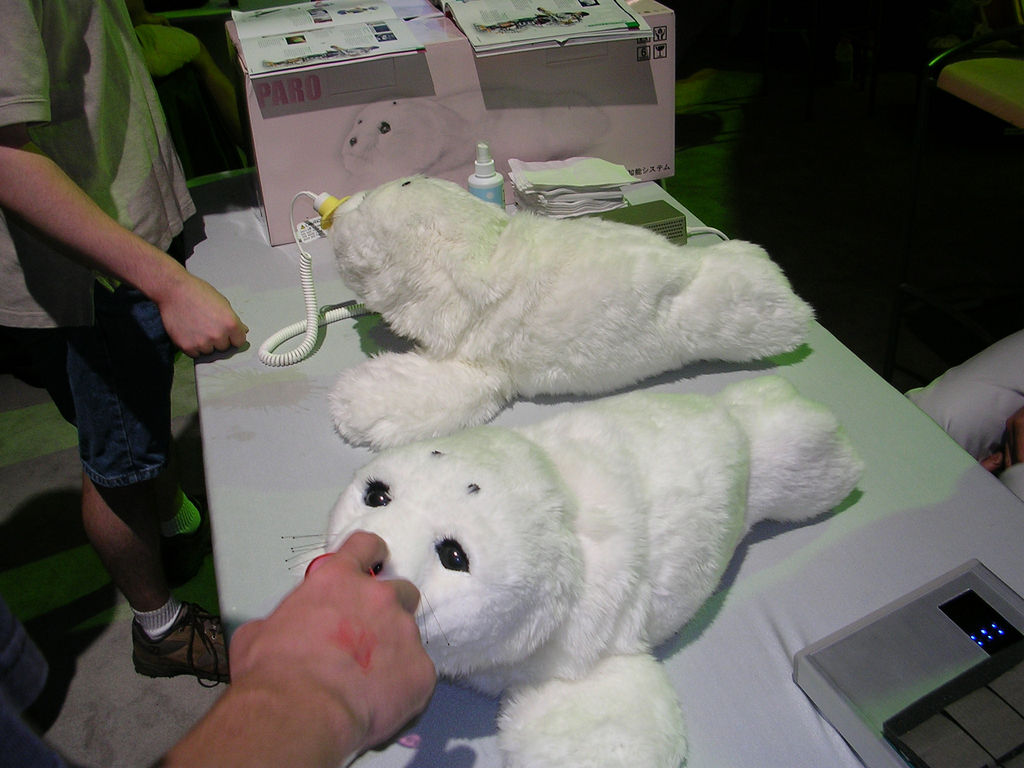
*Photo: Aaron Biggs / Wikimedia Commons (CC BY-SA 2.0).*
Why a Robot Can Beat Passive Screens (Without Beating People)
AARP's survey helps explain the gap. Many lonely adults use social media, yet a majority said communicating online rather than in person made them feel lonelier. Scrolling is easy. Being invited into a conversation is different.
Companion robots sit between a passive screen and a human visit:
| Support type | What it does well | Where it falls short |
|---|---|---|
| Social media / TV | Distraction, news, some remote contact | Often one-way; can deepen loneliness |
| Phone / video call | Real relationship repair | Depends on other people's schedules |
| Companion robot | Proactive daily prompts, games, reminders, presence | No human empathy; privacy and trust must be managed |
| In-person caregiver or family | Touch, judgment, complex care | Cost, distance, and [caregiver burnout](https://www.rhem.ai/blog/how-to-spot-caregiver-burnout-and-reduce-the-daily-load) limit hours |
The useful mental model is a bridge, not a replacement. Robots hold the middle of the day so the evening call with a daughter is not the only human-shaped moment. That same logic shows up across eldercare robotics more broadly, from market arguments about why eldercare matters for humanoids to practical home health features.
*Photo: Pexels (free to use).*
How Families Can Try a Companion Robot Without Replacing People
Use a short trial plan. Keep expectations concrete.
1. Name the lonely hours
Track a week. Is the hard stretch after breakfast, late afternoon, or Sunday evening? Match the robot to that window, not to an abstract fear of aging.
2. Set a human baseline
Keep at least a few scheduled real contacts (calls, visits, faith or community groups). The robot should support those habits, not erase them. If your parent hides health worries, a robot that only chats about the weather will miss the point. Look for gentle check-ins they will actually answer.
3. Pick the right form factor
Tabletop conversational robots suit people who want talk and games. Therapeutic pets suit people who want soft presence and less conversation. Mobile home robots add the ability to find someone in another room, which helps when loneliness pairs with mobility limits or quiet falls risk elsewhere in the care plan.
4. Agree on privacy in plain language
Ask vendors what is recorded, where audio goes, who can see transcripts, and how long data is kept. New York officials stressed partners that avoid collecting credit cards and medical details for their program. Families should ask the same questions at home.
5. Be honest that it is a machine
Tell your parent what the robot can and cannot do. People who enjoy companions still benefit from knowing they are talking to software. That reduces false expectations and protects dignity.
6. Watch for the wrong fit
Programs in New York do not give these companions to people with dementia when the device may confuse rather than comfort. If cognition is changing, talk with a clinician before adding a chatty robot. A calming pet robot or purely practical reminders may be safer.
*Photo: Pexels (free to use).*
Practical Ways a Home Robot Reduces Lonely Hours
Here is what "help" looks like day to day:
- Morning greeting that starts a short conversation so the day has a first social beat
- Activity suggestions that break long sedentary stretches
- Reminders to reach out when the person would otherwise wait for others to call first
- Shared rituals such as coffee talk, a joke, or a game at a fixed time
- Family awareness when the product offers opt-in status or message features (with consent)
- Continuity during travel so adult children can leave town without the house going silent
None of that replaces hands-on care. It reduces the emotional load that makes caregiver burnout worse when every quiet hour becomes a worry spiral.

*Photo: Pexels (free to use).*
Limits, Risks, and Honest Expectations
Companion robots are tools. Treat them that way.
- They do not diagnose or treat depression. Persistent hopelessness, withdrawal, or talk of self-harm needs a clinician, not a chatty device.
- They can create attachment. That can be comforting and still deserves family awareness.
- Privacy and scams matter. Older adults are frequent fraud targets. Prefer products with clear data policies and no surprise upsells inside the conversation.
- Evidence quality varies by product. Prefer programs and peer-reviewed evaluations over marketing claims alone.
- Culture and language fit matter. A robot that cannot speak the user's preferred language or respect their routines will sit unused.
Rhem Labs is building toward home robots that combine companionship with practical health support, because loneliness rarely shows up alone. Falls, vitals, and medication habits live in the same house. The product goal is still the same as the best public programs: more good hours at home, with people still at the center.

*Photo: Unsplash (free license).*
FAQ: Companion Robots and Loneliness
Do companion robots replace caregivers?
No. Caregiving needs judgment, touch, and advocacy. Robots handle repetitive social prompts and some reminders so humans can spend limited hours on higher-value care.
Are companion robots only for people who live alone?
They help most when alone time is long, but couples and multi-generational homes also use them for daytime company when family is at work.
How quickly do people feel less lonely?
Program reports describe meaningful improvements with regular use, but individual results vary. Give a serious trial of several weeks before judging.
What should adult children say when introducing one?
Try: "This is a machine that can talk with you between our calls. It is not a person, and it is not here to replace us. If you dislike it, we stop."
Where does Rhem fit?
Rhem is an in-home health companion robot direction for families who want aging-in-place support that includes connection, not only alarms. Learn more at rhem.ai.
Conclusion
Loneliness in later life is common, measurable, and medically serious. Companion robots help when they add proactive company, light structure, and bridges back to real people. The strongest programs treat technology as a complement to home visits, wellness services, and family contact.
If you are building a care plan for a parent who spends too many hours alone, put connection on the same list as falls and medications. A carefully chosen companion robot can make the quiet parts of the day lighter while you keep showing up as the human they actually need.
Next step: Explore how a home robot can support daily life at rhem.ai, and read our related guides on companion robots and aging in place when you are ready to compare options.